Floor to treetop
Up through the canopy
Most rainforest life is above your head. This page climbs from the floor to the top of the tallest tropical tree ever measured. The Canopy Lift does the same thing with a slider.
An estimated 50 to 90 percent of life in the rainforest lives in the trees, above the shaded floor, in Mongabay’s estimate.1 Mongabay divides primary tropical rainforest into at least five layers, the overstory, canopy, understory, shrub layer and forest floor, and adds that the layers are not always distinct and vary from forest to forest.1 Our layers page gives NASA’s three layers and Britannica’s 30 to 50 metre canopy.
The floor: bring a torch
The floor of primary rainforest is rarely the tangled jungle of films. It is fairly clear, because perhaps 30 metres (100 feet) of canopy above keeps it dark; in Mongabay’s words, a flashlight may be more useful than a machete.2 Under a full canopy only 1 to 5 percent of the sunlight reaches the floor. When a giant tree falls, usually in a storm, it opens a “light gap” where direct sun reaches the ground.3
The canopy also catches the rain. A visitor on the floor may not at first know it is raining, because the raindrops are deflected and collected by the plants above.2
The soil is poor. Over two-thirds of the world’s rainforests, and three-quarters of the Amazon rainforest, grow on red and yellow clay-like soils that are acidic and low in nutrients, which Mongabay calls “wet deserts”.4
The shrub layer and understory
The shrub layer is shrubs and young trees growing only 5 to 20 feet (about 1.5 to 6 metres) off the floor. Above it, the understory is more widely spaced, smaller trees and young ones, forming a broken layer below the canopy.1
The canopy: trees that do not touch
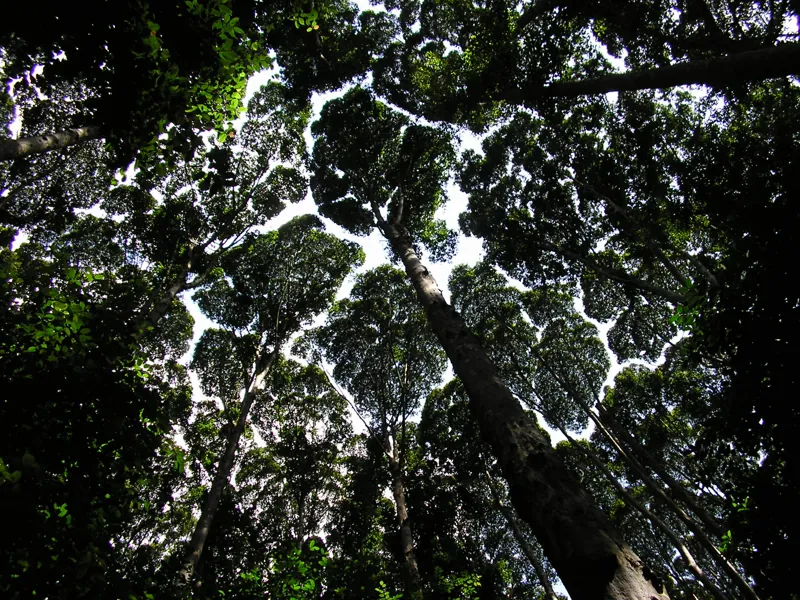
From an aeroplane the canopy looks unbroken, but canopy trees rarely interlock or even touch. Why is still a mystery; one idea is that the gaps protect them from leaf-eating caterpillars and diseases.1 The canopy is the richest part of the forest, 3 to 12 metres (10 to 40 feet) thick, and animals usually thought of as ground-dwellers, including worms, crabs, frogs, kangaroos, anteaters and porcupines, have adapted to live up there.5
Leaves at the top of the canopy, in full sun, are usually small and waxy to hold water. Leaves lower down, in shade, are often a darker blue-green.5 As many as 70 to 90 percent of canopy tree species depend on animals to carry their pollen and seeds.5
Scientists were slow to get up there. Early methods included felling whole trees and shooting down branches with shotguns, and one scientist in Borneo trained a monkey to bring down epiphytes. In 1990 a balloon-raft was placed on top of the canopy in West Africa and French Guiana, and the Smithsonian Tropical Research Institute in Panama uses a construction crane.6
The emergents
Above the canopy stand scattered emergent trees, some taller than 65 metres (213 feet), with horizontal limbs stretching over 30 metres. The air up there is drier and windier.7 More than 2,000 epiphytes and 1,500 lianas may be found on a single emergent tree.7
Menara, the tallest tropical tree
In 2019 scientists described the tallest tropical tree yet recorded: a yellow meranti, Shorea faguetiana, in the Danum Valley Conservation Area in Sabah, Malaysian Borneo. They named it Menara, Malay for “tower”.8 It was first spotted in an airborne laser (LiDAR) survey. In January 2019 a local climber, Unding Jami, climbed it with a tape measure: 100.8 metres. Laid down, Nottingham says, it would stretch beyond both goals of a football pitch.8
The scientists’ paper gives the details. Menara is 212 cm across above its buttress, and its above-ground mass is estimated at 81,500 kg, only 5 percent of it in the 40-metre-wide crown and 95 percent in the trunk.9 It is probably the tallest flowering plant, too: measured from the lowest point of the buttress it beats the 99.67 m of “Centurion”, a Tasmanian eucalyptus measured in 2016, although the paper notes room for argument about how the base is defined. The tallest conifer on record, a coast redwood called Hyperion, is 115.7 m; conifers are not flowering plants.9
Why not taller? The paper’s analysis suggests Menara would have to reach about 255 metres to buckle under its own weight, but could break in moderate winds, and the tallest trees in Danum seem to grow only on slopes sheltered from the prevailing wind. The authors argue that about 100 m is close to the maximum for a flowering tree.9
Heights from different sources: NASA says canopy trees grow to 75 m or more; Britannica says the canopy extends to 30 to 50 metres; Mongabay says some emergents exceed 65 m. They are describing different things, typical canopy and exceptional emergents, and the fact-check log keeps them side by side. Menara is a single measured tree.