The numbers
Changing rainforests
How fast are rainforests disappearing? The most-quoted figures come from satellites, and they need reading carefully.
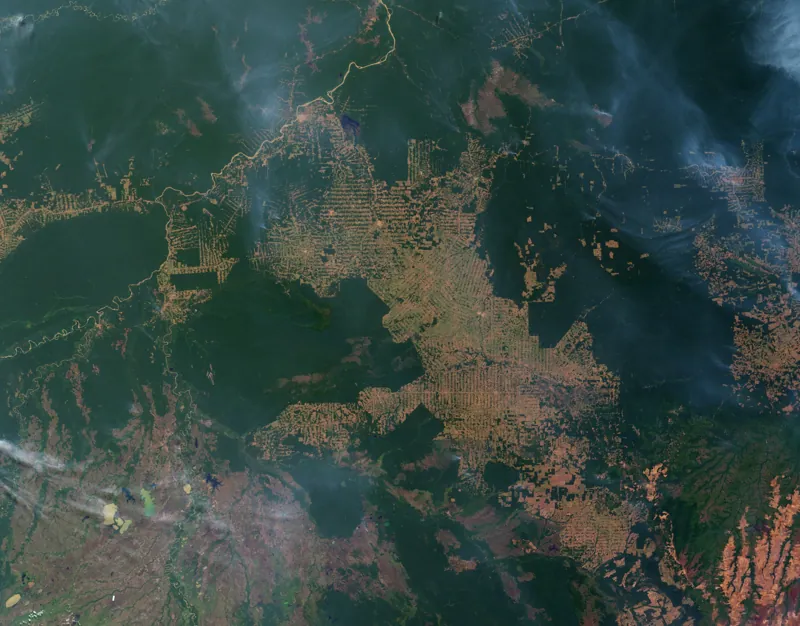
The 2025 figures
The World Resources Institute’s Global Forest Review, using University of Maryland satellite data, says the world lost 4.3 million hectares of tropical primary forest in 2025, more than 11 football pitches of forest every minute.1 That was 36 percent less than in 2024, a record-shattering year driven by extreme fires, but still 46 percent higher than a decade ago.1
The data measures “tree cover loss”, not deforestation. It counts fire and natural damage as well as clearing; the review focuses on the tropics because that is where 94 percent of deforestation, the human-caused, long-term removal of forest, takes place.1 Primary forests are mature rainforest, especially important for biodiversity.1
Country by country
- Brazil cut its primary forest loss by 42 percent in 2025, but still lost more tropical rainforest than any other country, because its forests are so large.1
- Bolivia had its second-highest loss on record, after record fires in 2024, and lost more primary forest than the Democratic Republic of the Congo despite having 60 percent less of it. Much of the loss was from fires, likely set by people.1
- Indonesia’s loss rose by 14 percent from 2024 to 2025, though it stayed well below the highs of the mid-2010s.1
- Brazil, Colombia, Indonesia and Malaysia all reduced or held steady their forest loss in 2025.1
Fire, and a lag
Some of the fire loss counted in 2025 happened in late 2024, when smoke and haze delayed satellite detection. That makes it hard to say exactly how fire loss changed between the two years.1 The review says fire has become an increasingly prominent cause of forest loss, partly because of feedback loops from climate change, and that forests do not always recover.1
Drought and rain
Rainforests help make their own rain: Mongabay says large rainforests can generate as much as 75 percent of their own rain, and the Amazon as much as 50 percent.2 It adds that deforestation and climate change may be affecting the water cycle in tropical rainforests, which have had periods of severe drought since the mid-1990s.2 The Amazon’s flying rivers are on the Amazon page.
Two kinds of number: satellite “tree cover loss” and national deforestation figures measure different things and will not match. The Amazon’s share of the world’s life is another figure that sources give very differently; the life page keeps both.