Still being found
Rainforest discoveries
Rainforests are some of the most studied places on Earth and still some of the least known. These finds were all made in the last few decades, most with new tools: lasers, satellites and patient fieldwork.
2019: a tree over 100 metres
Menara was spotted in an airborne LiDAR survey, where laser pulses bounce off the canopy and the ground.1 The paper notes that airborne LiDAR can make big errors on single trees, especially on hills, so record claims need checking with ground laser scans and, ideally, a tape. Researchers scanned the tree in August 2018 and climbed it in January 2019.2 The tape said 100.8 m.1
2024: cities under the Amazon
In the Upano Valley of Amazonian Ecuador, more than 20 years of fieldwork and LiDAR mapping revealed more than 6,000 earthen platforms and plazas, connected by roads and surrounded by farmland, across 300 square kilometres. The team identified at least 15 settlements, occupied from about 500 BCE to between 300 and 600 CE.3 It is the story of the people page.
2022: the frogs that hide their blood
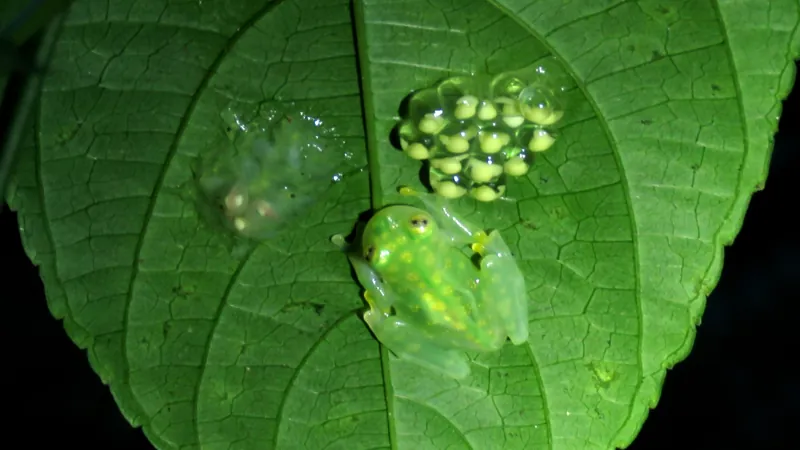
Sleeping glass frogs remove nearly 90 percent of their red blood cells from circulation and pack them into their liver, a 2022 study found, which is how they turn transparent on a leaf.4
2017: a new great ape
The Tapanuli orangutan, the southernmost orangutans on Sumatra, was described as a species in 2017. It has a slightly smaller skull, a shallower face, and consistent differences in skull, jaw and tooth measurements.5
2017: a hidden peatland
Under swamp forest in the central Congo Basin, researchers mapped about 145,500 square kilometres of peat, the most extensive peatland complex in the tropics, holding an estimated 30.6 billion tonnes of carbon.6 More on the Congo page.
2014: the moths that live on sloths
Sloth moths lay their eggs in sloth dung, and their adults live in sloth fur. Researchers found that sloths with more moths had more nutrient-rich fur and more algae.7
2009: a toilet for tree shrews
A study of Borneo’s Nepenthes lowii found that tree shrew droppings supply between 57 and 100 percent of the nitrogen in the leaves of mature plants.8
2009: elephants that plant trees
Forest elephants in the Congo were found to disperse more than 96 species of plants, carrying seeds as far as 57 km.9
1901: the okapi
The okapi was known to the Indigenous people of the Ituri Forest for generations. Scientists did not know of it until 1901.10 Plenty of rainforest knowledge is “discovered” only in this sense.
All the dates are on the rainforest timeline.